Introduction to the Primary Years Programme (PYP)
At Podar International School, we follow the IB Primary Years Programme from Grade 1 to Grade 5.
The PYP is a curriculum framework based on the most current best-practiced educational research from around the world. It prepares students for the intellectual challenges of further education and their future careers while focusing on the development of the whole child as an inquirer, both in the classroom and in the world at large. The programme aims to develop students' academic, social, and emotional wellbeing through a focus on international-mindedness and strong personal values.
© International Baccalaureate Organization 2024
The PYP Curriculum Framework
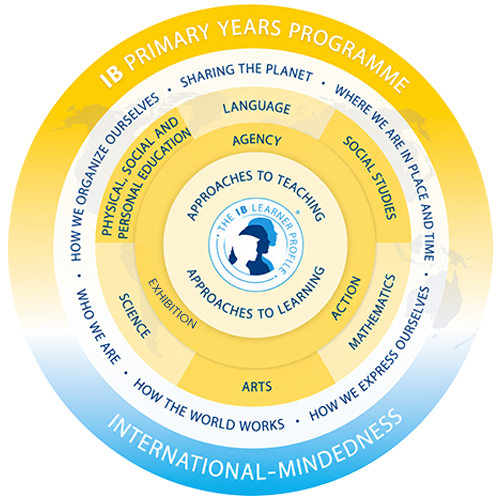
The Primary Years Programme (PYP) offers a transdisciplinary, inquiry-based and student-centered education with responsible action at its core, enabling students to learn between, across and beyond traditional subject boundaries.
The framework serves as the curriculum organizer and offers an in-depth guide to achieve authentic conceptual inquiry-based learning that is engaging, significant, challenging and relevant for PYP students.
Through the programme of inquiry and by reflecting on their learning, PYP students develop knowledge, conceptual understandings, skills and the attributes of the IB Learner profile. The Learner profile is the core of the model and the whole IB Philosophy, it also makes reference to the student-centered education.
The IB's six approaches to teaching and five approaches to learning guide and focus educators and students in IB World Schools.
The approaches are centred on a cycle of inquiry, action and reflection—an interplay of asking, doing and thinking—that informs the daily activities of teachers and learners. Agency and self-efficacy are fundamental to learning in the PYP. Throughout the programme, the learner is an agent for their own and others’ learning. They direct their learning with a strong sense of identity and self-belief, and in conjunction with others, build a sense of community and awareness for the opinions, values and needs of others.
Action, the core of student agency, is integral to the PYP learning process and to the programme’s overarching outcome of international mindedness.
Transdisciplinary Themes
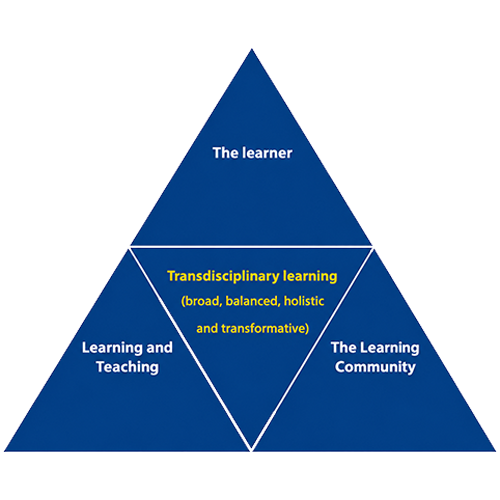
Figure 4
Transdisciplinary learning and the PYP framework
The pillars of the PYP curriculum framework
The transdisciplinary model extends across all three pillars of the PYP curriculum framework—the learner, learning and teaching, and the learning community.
- The learner: describes the outcomes for individual students and the outcomes they seek for themselves (what is learning?)
- Learning and teaching: articulates the distinctive features of learning and teaching (how best to support learners?)
- The learning community: emphasizes the importance of the social outcomes of learning and the role that IB communities play in achieving these outcomes (who facilitates learning and teaching?)
The Learner Profile
The attributes of the learner profile represent a broad range of human capacities and responsibilities that encompass intellectual, personal, emotional and social growth. The development and demonstration of these attributes are foundational to students becoming internationally minded, active and caring community members who respect themselves, others and the world around them.
The learner profile supports students in developing international-mindedness and in taking action for positive change. Exercising their agency, students take ownership of their learning, express their ideas and opinions, and reflect on their development of the learner profile attributes.
The Learner Profile in action
The learner profile supports students in developing international-mindedness and in taking action for positive change. Exercising their agency, students take ownership of their learning, express their ideas and opinions, and reflect on their development of the learner profile attributes.
Students have a range of opportunities to develop, demonstrate and reinforce attributes of the learner profile in the daily life of the learning community. They become embedded across the learning environment and are visible in the following areas:
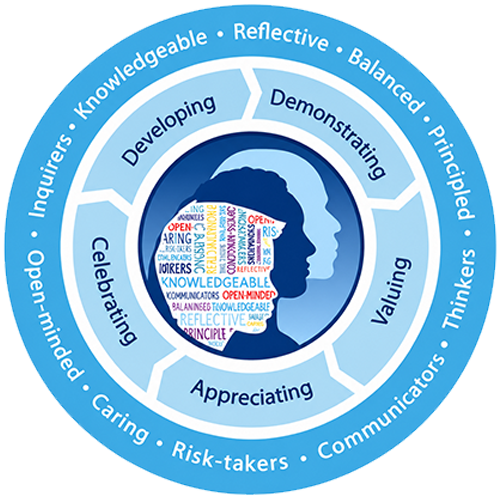
Figure LP02
Learner profile in action
Curriculum
The learner profile is integrated throughout the school's curriculum. Students engage with the attributes through transdisciplinary units of inquiry as well as subject-specific learning, where they explore conceptual understandings, build skills and take meaningful action.
Learning spaces and social interactions
Opportunities to apply and practice the learner profile attributes are present in diverse learning spaces such as the library, music room, and across everyday social contexts. This includes interactions during break and lunch times, sports, after-school activities, and field trips.
School events
Events such as assemblies, drama productions, and sports days provide further occasions for students to showcase and deepen their understanding of the learner profile. These collective experiences help foster a shared sense of identity and community.
Home and wider community
The development of the learner profile extends beyond the school. Through interactions with family members, friends, local businesses, sports clubs and community groups, students have the opportunity to embody the attributes in real-world contexts.
School culture and communication
The learner profile shapes the culture of the school, evident in class agreements, playground expectations, and pastoral care approaches. It also serves as a common language in communications through newsletters, school websites, and visual displays.
Feedback and reflection
Students regularly use the learner profile to reflect on their learning and to provide and receive feedback. The attributes are highlighted and celebrated in learning journals, reports, and peer interactions, supporting growth and constructive dialogue.
Critical thinking tools
The learner profile offers a framework for critically exploring local and global challenges. Students learn to question and analyze various perspectives, communication styles, and social issues using the lens of the learner profile.
Approaches to Teaching
To foster this dynamic environment, our educators are guided by the IB’s six key pedagogical principles. Teaching at Podar International School is:
- Based on Inquiry: We believe students learn best by asking questions and exploring the answers.
- Focused on Conceptual Understanding: We move beyond memorization to help students grasp big ideas.
- Developed in Local and Global Contexts: Learning is connected to students’ lives and the wider world.
- Focused on Effective Teamwork and Collaboration: We teach students how to work together to achieve common goals.
- Designed to be Inclusive: Our teaching is differentiated to meet the needs of all learners.
- Informed by Assessment: We use a variety of assessments to provide feedback and support student growth.
Student agency is fundamental to this process. Learners at Podar direct their own learning with a strong sense of identity and self-belief. Action, the core of student agency, is integral to the PYP, empowering students to make a positive impact on the world.
Explore the PYP at Podar
We invite you to discover how the Primary Years Programme at Podar International School can nurture your child’s potential.
- PYP Brochure to learn more about our unique implementation of this world-class programme.
- Learn more about the Primary Years Programme on the official International Baccalaureate website
- Check out this interactive resource to learn more about the PYP:
https://www.ibo.org/professional-development/free-learning/pyp-pd-learning-resources/pyp-playlist/
