Introduction to Cambridge Advanced (A Levels)
The Cambridge International AS & A Level qualification is designed to develop learners’ knowledge, understanding, and skills for the modern world.
At Podar International School, we follow this globally recognized curriculum to prepare students for the intellectual challenges of university and their future careers. The programme focuses on developing a deep understanding of subjects while fostering independent thinking and the ability to apply knowledge to unfamiliar situations.
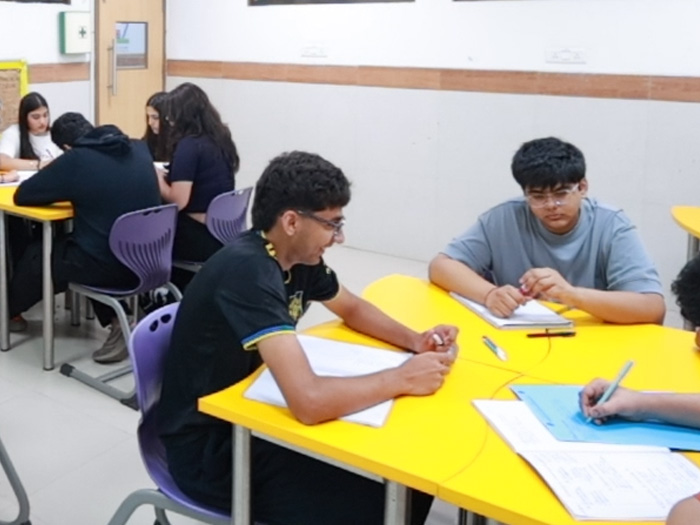
Key Learning Outcomes
Our students are trained to think logically and present ordered, coherent arguments. Through this curriculum, learners develop the following skills:
- In-depth subject content and independent thinking
- Handling and evaluating different types of information sources
- Making judgments, recommendations, and decisions
- Communicating reasoned explanations logically and clearly
- Advanced proficiency in working and communicating in English
AS & A Level Curriculum
Students opt for four subjects, with English being a compulsory component, alongside three additional subjects from their chosen stream.
Science Stream
Select any three subjects:
- Physics
- Chemistry
- Biology
- Mathematics
- Computer Science
- Art and Design
Commerce & Humanities Stream
Select any three subjects:
- Accounting
- Business Studies
- Economics
- Mathematics
- Art & Design
- Psychology
Syllabus Details
Group 1: Mathematics and Science
Group 2: Languages
Group 3: Arts and Humanities
Cambridge Learner Attributes
How we support and develop students through the Cambridge framework:
Confident
Students are keen to explore and evaluate ideas and arguments in a structured, critical and analytical way. They communicate and defend views while respecting those of others, such as presenting findings from science experiments to peers.
Responsible
Students take ownership of their learning and insist on intellectual integrity. They understand that their actions have impacts on others and the environment, ensuring they follow safety protocols during practical lab work.
Reflective
Students understand themselves as learners. They develop awareness and strategies to be life-long learners, learning from errors in financial statements or evaluating the ethical impact of research.
Innovative
Learners welcome new challenges creatively. They apply knowledge to solve unfamiliar problems, such as designing a new experiment to test a scientific principle or proposing solutions to economic problems.
Engaged
Students embody a spirit of enquiry. They follow current economic news and apply theories to real-world situations, exploring science applications and connecting math concepts to finance and physics.
