Middle Years Programme (MYP) - Grades VI and VII
Podar International School is a Candidate School* for the MYP programme and is pursuing authorization as an IB World School. IB World schools share a common philosophy—a commitment to high quality, challenging, international education that we believe is important for our students.
*Only schools authorized by the IB Organization can offer any of its four academic programmes: the Primary Years Programme (PYP), the Middle Years Programme (MYP), the Diploma Programme, or the Career-related Programme (CP). Candidate status gives no guarantee that authorization will be granted.
At Podar, we believe in nurturing lifelong learners by providing meaningful, challenging, and internationally minded learning experiences that develop curiosity, responsibility, and a strong sense of values. Our approach to education focuses on holistic development, encouraging students to think critically, act ethically, and grow into confident global citizens.
For further information about the IB and its programmes, visit www.ibo.org
© International Baccalaureate Organization 2024
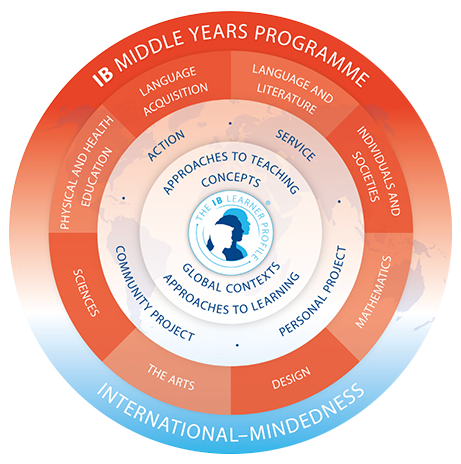
The programme model of the MYP places the learner at its centre. This underscores the IB's belief in educating the whole person, and it places importance on student inquiry. The eight subject groups ensure a balanced and varied learning experience. Each subject group has its disciplinary foundations and its own shared methodologies and perspectives.
Approaches to teaching and learning, concepts and global contexts are reflected as central elements of the programme that guarantee a “common language” for all subject groups and enable interdisciplinary connections across disciplines. These elements establish meaningful connections between what students learn inside the classroom and the world beyond. Contexts and concepts are essential components for promoting holistic learning.
MYP global contexts
- Identities and relationships
- Orientation in space and time
- Personal and cultural expression
- Scientific and technical innovation
- Globalization and sustainability
- Fairness and development
IB learners and the IB learner profile
At the centre of international education in the IB are students with their own learning styles, strengths and limitations. Students come to school with combinations of unique and shared patterns of values, knowledge and experience of the world and their place in it.
The learner profile is the IB's mission in action. It requires IB learners to strive to become inquirers, knowledgeable, thinkers, communicators, principled, open-minded, caring, risk-takers, balanced and reflective. These attributes of internationally minded people represent a broad range of human capacities and responsibilities that go beyond a concern for intellectual development and academic content. They imply a commitment to implement standards and practices that help all members of the school community learn to respect themselves, others and the world around them.
https://ibo.org/benefits/learner-profile/Subject Groups in the MYP Curriculum
The MYP offers a broad and balanced curriculum through eight subject groups, providing students with diverse opportunities to develop knowledge, conceptual understanding, and essential skills. Alongside dedicated learning within each discipline, interdisciplinary experiences encourage students to make meaningful connections across subjects and apply their learning to authentic contexts.

Service as action
The Community Project and Personal Project
The Community Project focuses on community and service, encouraging students to explore their right and responsibility to implement service as action in the community. As a consolidation of learning, the community project engages in a sustained, in-depth inquiry leading to service as action in the community.
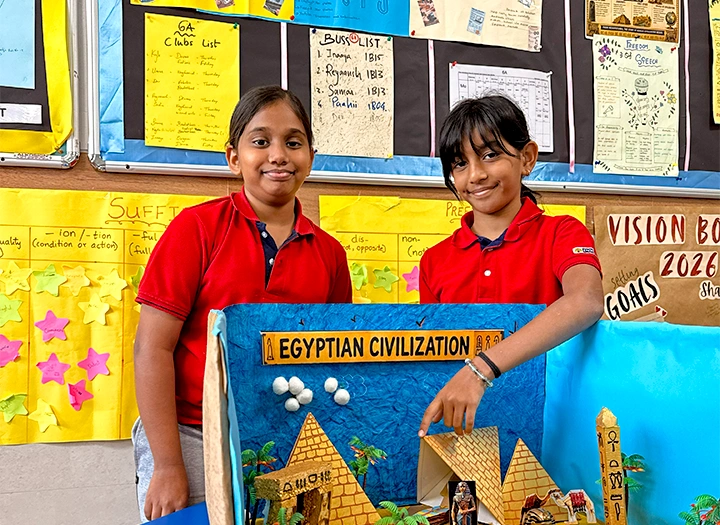
The Personal Project provides an excellent opportunity for students to produce a truly personal and often creative product/outcome and to demonstrate a consolidation of their learning in the MYP. The personal nature of the project is important; the project should revolve around a challenge that motivates and interests the individual student.
Transition from the PYP to DP/CP
The foundational principles of the MYP come from the continuum elements from PYP. Transdisciplinary themes become global contexts. These global contexts - identities and relationships, Orientation in space and time, Personal and cultural expression, Scientific and technical innovation, Globalization and sustainability, Fairness and development, assist learners gain a deeper understanding of local and global challenges.
Interdisciplinary learning experiences further enrich this journey by enabling students to integrate knowledge, skills, and perspectives from multiple subject groups to address authentic challenges. These experiences foster collaboration, confidence, independent thinking, and a sense of agency, empowering students to recognise that their actions can make a positive difference.
Approaches to learning (ATL)
| ATL skill categories | MYP ATL skill clusters |
|---|---|
| Communication | I. Communication |
| Social | II. Collaboration |
| Self-management | III. Organization |
| IV. Affective | |
| V. Reflection | |
| Research | VI. Information literacy |
| VII. Media literacy | |
| Thinking | VIII. Critical thinking |
| IX. Creative thinking | |
| X. Transfer |
Explore the MYP at Podar
We invite you to discover how the Middle Years Programme at Podar International School can nurture your child’s potential.
Check out this interactive resource to learn more about the MYP:
https://ibo.org/professional-development/free-learning/myp-pd-learning-resources/